What Is Brand Identity?
Brand identity is the full set of visual and verbal elements, logo, colour palette, typography, imagery style, and tone of voice, along with the rules that hold them together, that make a business recognisable and consistent everywhere it shows up. It's broader than a logo and more concrete than a "brand strategy". For a small business commissioning design work, knowing where brand identity starts and stops is what turns a vague brief into a usable one.
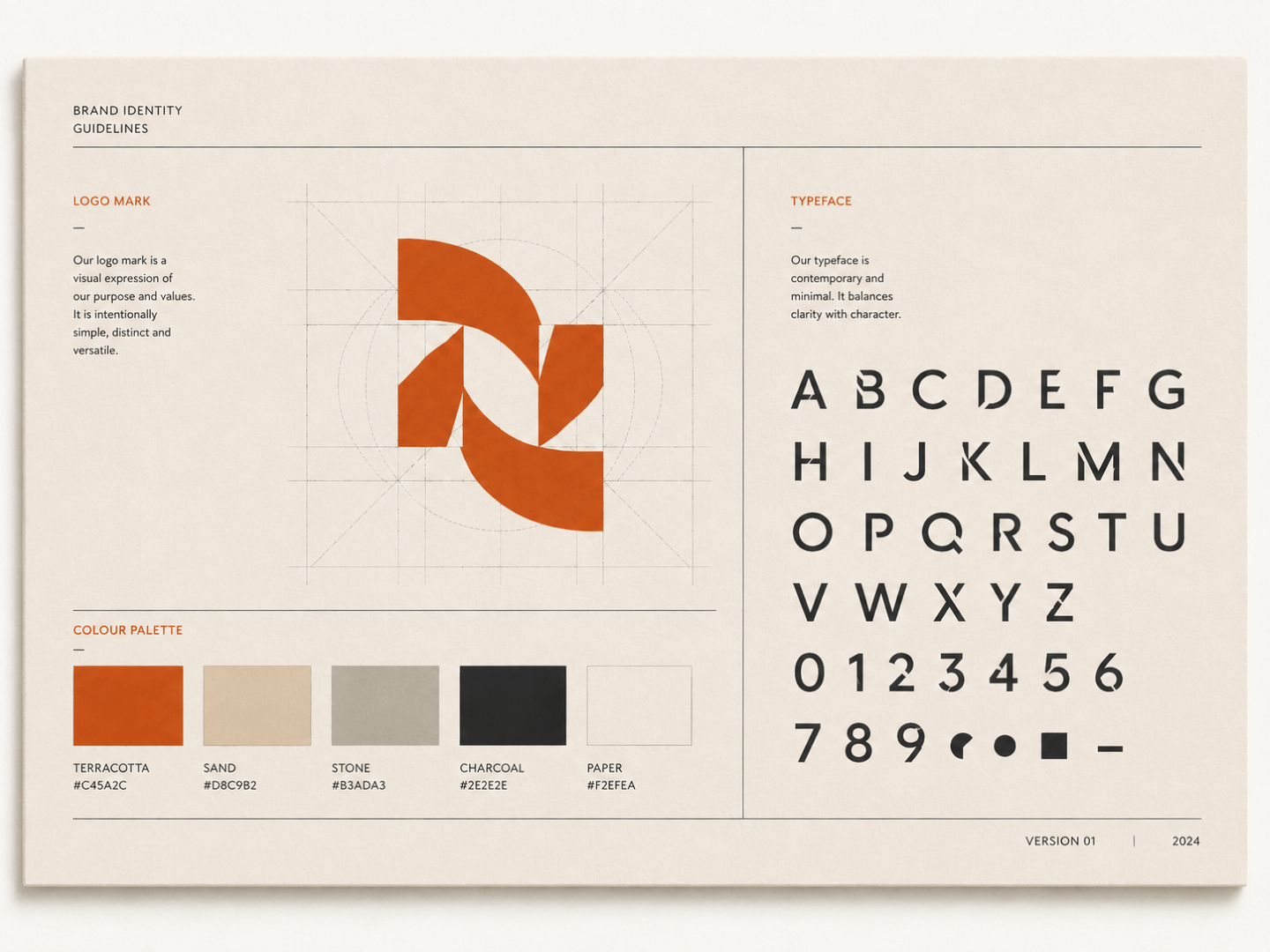
- Brand identity is the full visual and verbal system, not just a logo: colour, typography, imagery, tone of voice, and the rules connecting them.
- Brand strategy answers who and why; brand identity is the tangible expression built from those answers.
- A style guide documents the rules of an identity that already exists. It doesn't create the identity itself.
- A logo project and a full identity project are scoped and priced differently because they involve different amounts of work.
- Skipping strategy and identity work to jump straight to a logo is a common reason business owners end up redesigning within a year or two.
What's Actually Included in a Brand Identity
A brand identity is a system of interconnected parts, not a single asset. At minimum, it covers:
- A primary logo mark, plus acceptable variations such as a submark, icon-only version, and horizontal lockup
- A defined colour palette, usually specified in hex, CMYK, and Pantone where print is involved, with primary and secondary colours assigned specific uses
- A typography system, headline and body fonts, with rules for hierarchy and pairing
- An imagery or illustration style that stays consistent across the website, social media, and print material
- A tone of voice, how the business writes and speaks, which sometimes sits with marketing rather than the designer but should still be documented alongside the visual system
This is also where a lot of the confusion around pricing starts. A logo design project and a full brand identity project are scoped differently because they involve genuinely different amounts of work, one produces a mark, the other produces a system built around that mark. We've broken down what actually drives the cost difference in logo design pricing in Australia.
Brand Identity vs Brand Strategy
Brand strategy comes before identity and answers a different set of questions: who the business serves, what it stands for, how it's positioned against competitors, and what it promises to deliver. Brand identity translates those answers into something visible and usable.
Without strategy behind it, identity work becomes guesswork. A designer ends up choosing colours and fonts based on personal taste or current trends rather than what will actually resonate with the business's real audience. This is why a good design brief includes context on the business and its customers, not just a list of colours the owner likes. If you're preparing to commission identity work, how to brief a graphic designer covers what that context should include.
Brand Identity vs a Style Guide
A style guide isn't the identity. It documents the identity. Once the logo, palette, typography, and imagery style have been decided, the style guide, sometimes called brand guidelines, is the reference document that shows how to apply those elements correctly and what to avoid.
A style guide without an identity behind it is just a template. An identity without a style guide tends to drift, inconsistent logo use, colours applied differently across channels, fonts substituted because nobody has a clear reference. For a small business, even a simple one or two page guide covering logo clear space, colour codes, and font names is worth having before the identity gets used across a website, packaging, and social media at once.
Why This Matters When Commissioning a Brand Identity
Understanding the scope of brand identity work before commissioning it changes two things: what you ask for, and what you budget for.
A business that asks a designer for "just a logo" but actually needs a full identity, because it's launching across a website, packaging, signage, and social media at the same time, will end up either underserved by the logo-only deliverable or back at the designer's door within months asking for the rest of the system. Being clear about scope from the start avoids both the wasted spend and the inconsistent rollout that follows.
It also affects how briefs get read. A designer working from a brief that names the actual deliverables, logo suite, colour palette, typography system, basic style guide, can scope and quote accurately. A brief that just says "brand identity" without specifying what's included leaves the designer guessing at scope, which usually shows up later as a quote that feels higher than expected for what the business owner assumed was "just a logo with some colours".
Frequently Asked Questions
- Do I need a full brand identity or just a logo?
- If the business only needs a mark for a single use case, a basic logo may be enough short term. Most businesses launching or growing across multiple channels, website, social, packaging, signage, need the fuller system: colour palette and typography at minimum. See logo design pricing in Australia for how the two are scoped differently.
- How much does a brand identity cost in Australia?
- Small business brand identity projects in Australia typically run from around $1,500 to $6,000 for logo, colour palette, typography system, and a basic usage guide. More comprehensive projects, additional brand assets, extensive guidelines, multiple concept rounds, run higher. The biggest cost driver is scope: how many deliverables are included and how much strategic work happens before the visual work starts.
- Can I create a brand identity myself?
- It's possible for a very early-stage or budget-constrained business using tools like Canva, but the result usually lacks the strategic thinking, in particular why these colours, why this typography, that gives an identity staying power. A DIY identity is often a reasonable placeholder, not a long-term system.
- Do I need a style guide if I'm a small business?
- Yes, even a simple one. Without a documented reference, identity elements tend to drift as soon as more than one person is producing content, whether that's the business owner switching fonts in a hurry or a freelancer picking the wrong shade of the brand colour.