Graphic Design Services Explained: What's Actually Included
A typical graphic design engagement moves through five stages: discovery, concept development, revisions, deliverables, and file handover. Knowing what happens at each stage, and what should reasonably be included, makes it easier to write a clear brief, read a quote with confidence, and spot the difference between a fair scope and a thin one, regardless of whether you're hiring a freelancer, a small studio, or a larger agency.
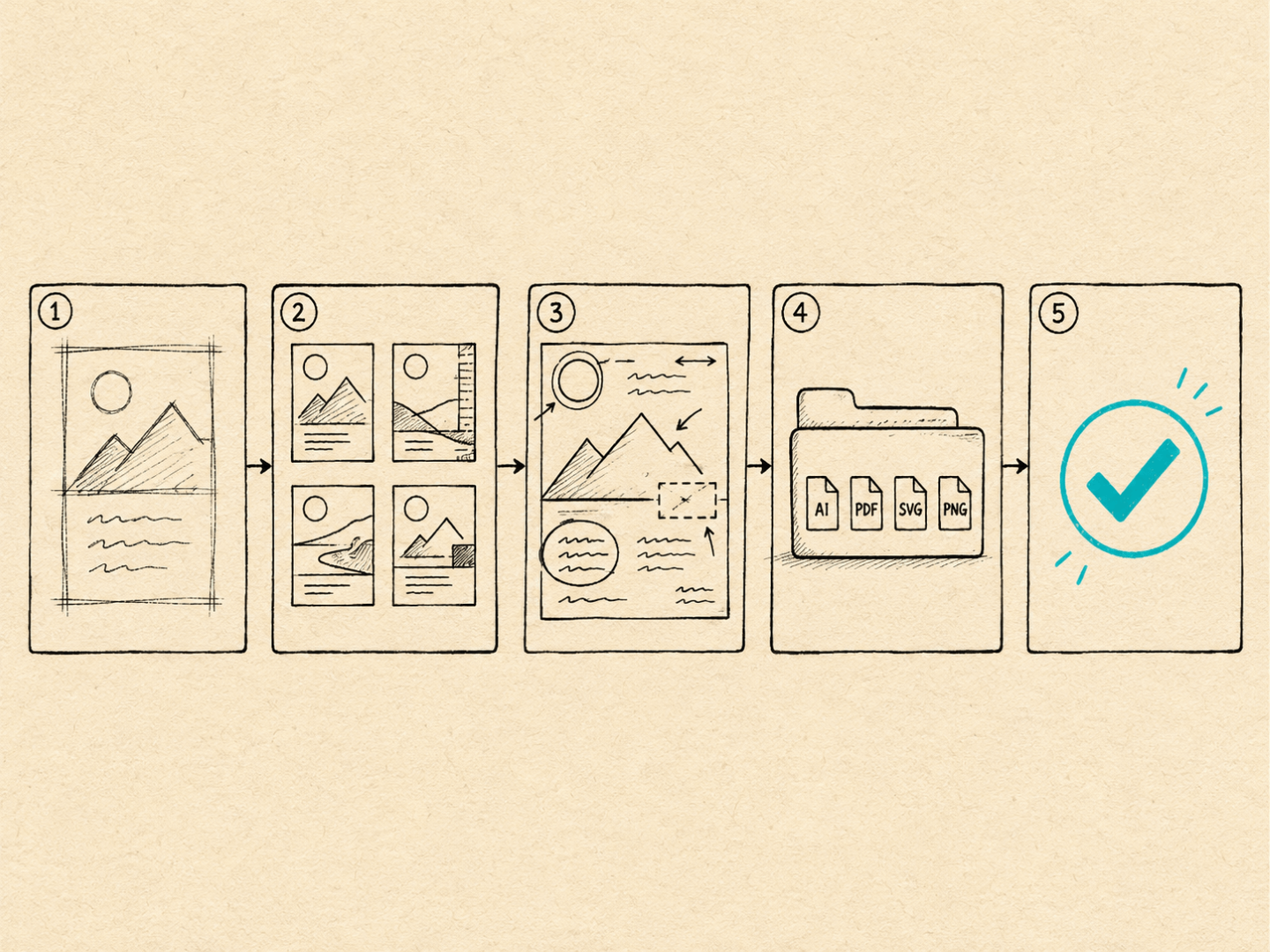
This guide is written for business owners preparing to commission design work. If you're a student or early-career designer, it doubles as a straightforward map of how professional engagements are structured, but the framing throughout is from the client's side of the table.
- Most design engagements follow five stages: discovery, concepts, revisions, deliverables, and handover, though the depth of each stage varies with scope and budget.
- Fixed-price quotes typically include two to three revision rounds; anything beyond that is usually billed separately.
- Final files and full usage rights are normally handed over only after final payment, not during the working process.
- What counts as a "deliverable" differs by project type: a logo project and a full brand identity project hand over different file sets.
- Freelancers, small studios, and agencies scope the same stages differently, mostly around how much strategy and iteration sits inside the price.
Discovery and briefing
Discovery is where the designer works out what the project actually needs before producing anything visual. For a competent engagement, this means understanding the business, the audience, the competitive landscape, and the practical constraints (where the work will be used, what sizes and formats are needed, what's already been tried).
A designer who skips discovery and jumps straight to concepts is usually working from assumptions rather than information, and the output tends to show it. Discovery can be a short conversation for a small project or a structured questionnaire and workshop for a larger one, but it should exist in some form.
The quality of this stage depends heavily on the brief you provide. Our guide on how to brief a graphic designer covers what a strong brief actually contains, since a vague brief produces a vague discovery phase no matter how skilled the designer is.
Concept development
Once discovery is complete, the designer produces initial concepts. This is the stage most people think of as "the design work," but it's really the output of everything decided in discovery.
How many concepts you should expect varies by project and budget. A single, well-considered direction is common for smaller or lower-budget projects. Two to three distinct directions is typical for larger identity or brand work, where the client needs genuine options to choose between rather than variations on one idea.
Concepts at this stage are usually presented as static visuals rather than fully built-out systems. A logo concept, for example, is shown in a handful of applications (business card, letterhead, a website mockup) to demonstrate how it works, not delivered as a complete file package. Full production happens after a direction is chosen.
Revisions and feedback rounds
Most fixed-price engagements include a set number of revision rounds, typically two to three. This is one of the most commonly misunderstood parts of a design quote: "revisions included" doesn't mean unlimited changes, it means a defined number of structured feedback cycles.
A revision round usually means the client reviews the work, provides consolidated feedback, and the designer makes the corresponding adjustments. Feedback given piecemeal over several days, or requests that amount to a new direction rather than a refinement, often falls outside what was scoped, and a reasonable designer will flag this rather than absorb it silently.
If a project needs more iteration than the quote assumed, that's not unusual, but it's worth knowing upfront that extra rounds are typically billed as additional time. Asking how many rounds are included, and what happens beyond that, is one of the more useful questions you can ask before signing off on a quote.
Deliverables and file formats
What you actually receive at the end of a project depends on what was commissioned. A logo project and a full brand identity project hand over very different file sets, and it's worth understanding the difference before assuming a quote covers more than it does.
For a logo specifically, deliverables usually include vector source files (AI or EPS), a scalable format for web and print use (SVG, PDF), and raster exports (PNG, JPG) in a few standard sizes and colour variations (full colour, black, white, reversed). Our breakdown of logo design cost in Australia covers how these deliverables typically map to different price points.
A full brand identity project goes further, usually including a brand guidelines document that covers colour palette, typography, logo usage rules, and applications across different materials. If you're trying to understand what "brand identity" actually covers as a discipline, our guide on what is brand identity explains the difference between a logo and a full identity system, which matters when comparing quotes that look similar in price but aren't scoped the same.
File handover and ownership
Final files and full usage rights are normally released once final payment is made, not progressively throughout the project. This is standard practice, not a red flag, and it protects the designer against handing over completed work that never gets paid for.
Before the project starts, it's worth confirming in writing what "final files" means for your project (which formats, source files included or not) and what happens to intellectual property on completion. Reputable designers are generally straightforward about this; vague or evasive answers on ownership are worth treating as a warning sign.
How this varies by provider type
The five stages above hold across freelancers, small studios, and agencies, but how much sits inside each stage changes considerably.
A freelancer working on a smaller project might compress discovery into a single conversation and move quickly to concepts, which suits straightforward projects with a clear brief. A small studio typically adds more structure to discovery and often provides two to three concept directions as standard. A larger agency usually adds a strategy phase ahead of discovery, more concept options, and a more formal presentation and sign-off process at each stage, reflected in both the price and the timeline.
None of these approaches is inherently better. The right fit depends on the complexity of the project and how much strategic input you actually need versus how much you already know about your own positioning going in.
What to ask before you commission work
- How many concept directions will be presented, and how many revision rounds are included?
- What happens if I need changes beyond the included rounds, and how is that billed?
- What file formats and source files are included in the final handover?
- When do usage rights and ownership transfer, and is that in writing?
- What does discovery actually involve for a project like mine?
Asking these upfront generally surfaces a clear, confident answer from an experienced designer, and a vague or defensive one from someone still working it out.
Frequently asked questions
- Is a logo project the same process as a full brand identity project?
- No. A logo project is scoped around one core asset and its immediate applications, while a full brand identity project covers a broader system including guidelines, typography, colour palette, and usage rules across multiple materials. The stages are similar, but the depth and deliverables at each stage differ significantly.
- How long does a typical graphic design project take?
- It depends heavily on scope, but a straightforward logo project often runs two to four weeks from discovery to final handover, while a full brand identity project can run six to twelve weeks or longer, largely driven by the number of revision rounds and how quickly feedback is provided at each stage.
- Should I expect a written contract or scope of work?
- Yes, for anything beyond a very small project. A written scope protects both sides by setting out what's included, how many revisions are covered, payment terms, and when ownership transfers, and its absence is worth treating as a caution sign.
- Can I ask for more revisions than what's quoted?
- Usually yes, but expect it to be billed as additional work beyond the included rounds. Most designers are upfront about this if asked directly before the project starts.
Design Junction is a content and resource site, not a design studio or service provider. For more on what the site is and isn't, see our About page. If you're interested in the discipline itself rather than commissioning work, our guide to graphic design career paths covers how people build a career in the field.